
Awards
IEEE Challenge Sphere 2025 Awards Ceremony
20 December, 2025
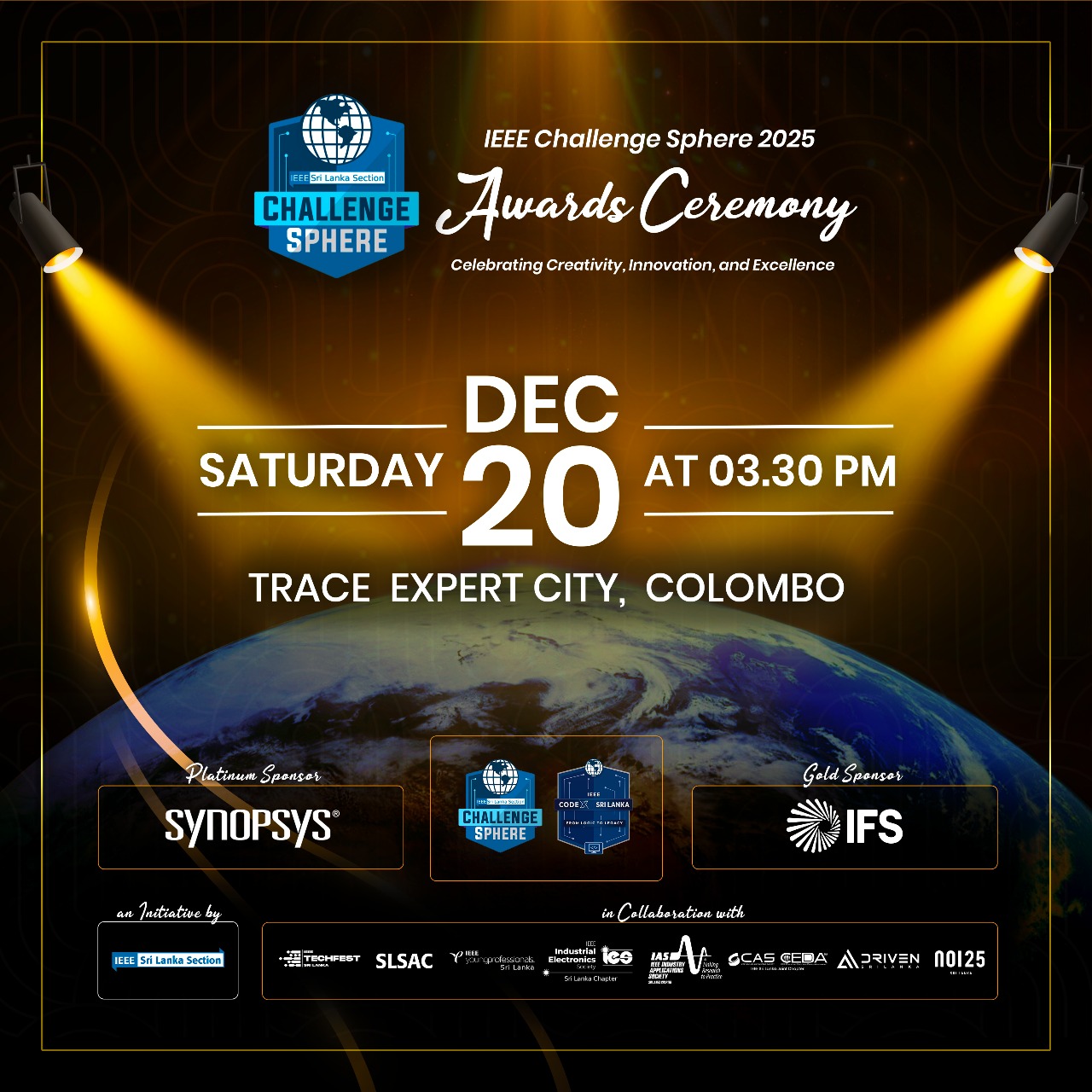
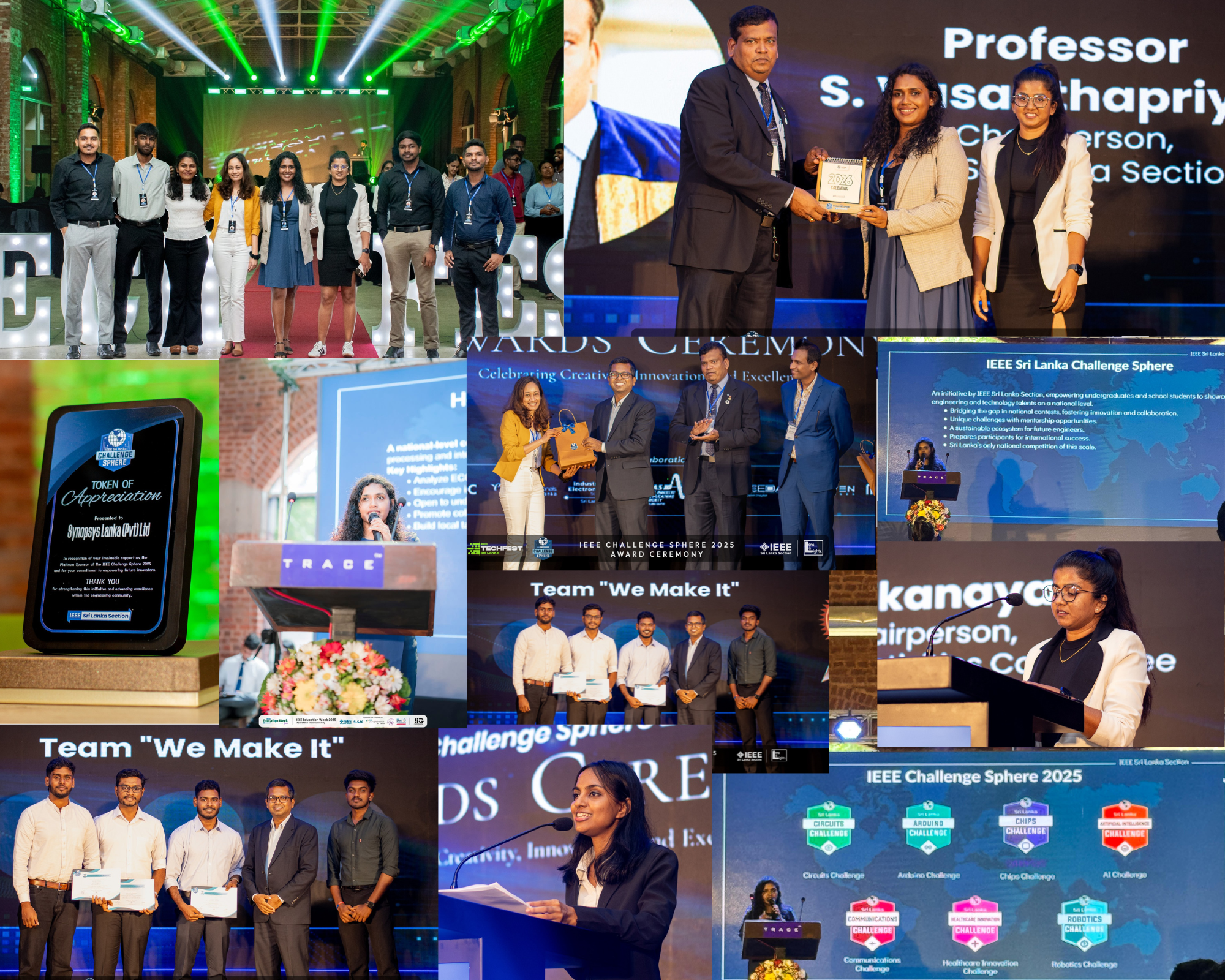
The IEEE Challenge Sphere 2025 Awards Ceremony, organised by the IEEE Sri Lanka Section, was held on 20 December 2025 at Trace Expert City, Colombo, as part of IEEE TechFest 2025. The initiative recognised outstanding young talent, promoted innovation and technical excellence, and provided nationally recognised platforms that bridge academia and industry while enabling global exposure.
These participants were selected to represent Sri Lanka at the International Olympiad in Informatics (IOI)
The success of IEEE Challenge Sphere 2025 was made possible through dedicated volunteers and strong industry support, with Synopsys Lanka (Platinum Sponsor) and IFS (Gold Sponsor) empowering the next generation of technology leaders.
-
CHIPS Challenge – Winning Participants
Organised by IEEE CAS & CEDA SL Joint Chapter | Powered by Synopsys Lanka- Rajinthan Rameshkumar – University of Moratuwa
- Thimira Hirushan Peiris – University of Peradeniya
- M.M.H.N.B. Marasinghe – University of Moratuwa
These participants were selected to represent Sri Lanka at the International Microelectronics Olympiad.
-
AI Challenge – Winning Teams
Organised by IEEE AI Driven Sri Lanka- Team TechBloom (University of Moratuwa): Aditha Buwaneka, Rashmitha Hansamal, Samasha Hettiarachchi, Nithila Thawalampitiya, Randitha Kulasekera
- Team Jaspern (University of Moratuwa): Jeewantha Sadaruwan, Savindu Dilshan Wickramasinghe, Nilesh Ravishan, Thevindu Kalubowila
- Team Bluewater (Informatics Institute of Technology, Sri Lanka): Khadheeja Alam, Raahim Aslam, Shahma Seeran, Nabeeha Thushan, Amna Shouqi
-
Arduino Challenge – Top-Performing Teams
Organised by IEEE Industrial Electronics Society SL Chapter- Team Voltron (University of Sri Jayewardenepura): T.K. Ellawala, H.A.N. Vihansith, P.K.C. Sachintha
- Team SLIIT Health Guard (SLIIT): Karunanayaka M.A.D.K., Gunasekara R.G.K.T.B., De Soysa W.S.D.
- Team We Make It (University of Sri Jayewardenepura): K.A.I.N.T. Nanayakkara, W.P.L.V. Ariarathne, W.P.H.G. Dharmapala
-
Applied Robotics Challenge – Winning Teams
Organised by IEEE Industry Applications Society SL Chapter- Team Pulztrones: Banuka Liyanage, Pankaja Balasooriya, Chandupa Dineshara, Chamath Diunugala, Oshani Dewasumithra
- Team TRIbots: L.H.H. Maduwantha
- Team Spark: Dasun Randesh, Nuwantha Senadhi Ranaweera, Thusith Wijewardena
-
National Olympiad in Informatics (NOI) – Winning Participants
Powered by IFS- Deera Wijesundara – Maliyadeva College, Kurunegala
- Malitha Bandara – Dharmaraja College, Kandy
- Praveen Charuka – The British School in Colombo
- Savindu Damsara – Maris Stella College, Thimbirigaskattuwa
These participants were selected to represent Sri Lanka at the International Olympiad in Informatics (IOI)
The success of IEEE Challenge Sphere 2025 was made possible through dedicated volunteers and strong industry support, with Synopsys Lanka (Platinum Sponsor) and IFS (Gold Sponsor) empowering the next generation of technology leaders.
Conferences
ICATC 2025
16 December 2025
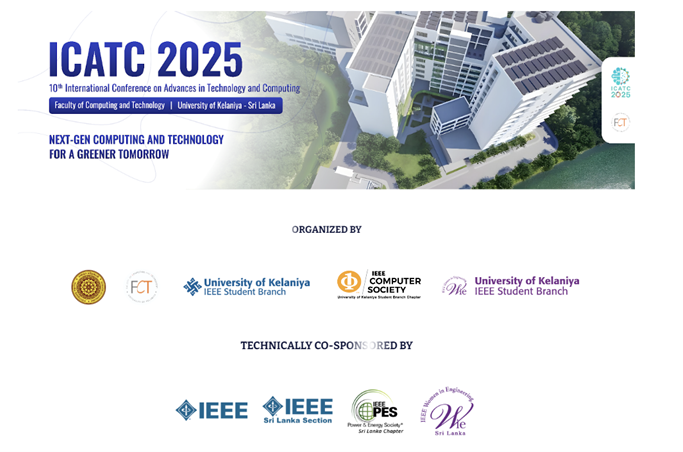
The 10th International Conference on Advances in Technology and Computing (ICATC 2025) was successfully held on 16th December 2025 at the Faculty of Computing and Technology, University of Kelaniya, in a hybrid format. The conference was organised by the Faculty of Computing and Technology, University of Kelaniya, in collaboration with the University of Kelaniya IEEE Student Branch, the IEEE Computer Society Chapter Student Branch, and the IEEE Women in Engineering Student Branch Affinity Group. The event was technically co-sponsored by IEEE, the IEEE Sri Lanka Section, the IEEE Power and Energy Society (PES) Sri Lanka Chapter, and the IEEE Women in Engineering Affinity Group of the Sri Lanka Section.
Held under the theme “Next-Gen Computing and Technology for a Greener Tomorrow”, ICATC 2025 provided a platform for academics, researchers, industry professionals, and students to present innovative research findings and engage in discussions on emerging trends in sustainable and next-generation computing technologies.
The inaugural session was graced by Senior Professor Nilanthi de Silva, Vice Chancellor of the University of Kelaniya, who served as the Chief Guest. In her address, she highlighted the importance of interdisciplinary collaboration, ethical innovation, and research-driven solutions in addressing global sustainability challenges.
The technical programme comprised 10 technical sessions, organised under two key tracks: the Computing Technology Track and the Engineering, Science and Technology Track. These sessions facilitated focused technical discussions and knowledge exchange across a wide range of computing and technology-related disciplines. The conference featured two keynote addresses by distinguished scholars. Professor Suranga Nanayakkara from the National University of Singapore delivered a keynote titled “Thinking outside the ‘Computer’ Box: Initial Steps towards Assistive Augmentations”, while Prof. Madhusanka Liyanage from University College Dublin delivered an online keynote titled “Securing the Unseen: XAI’s Role in the 6G Security”.
A key highlight of ICATC 2025 was the series of three specialised workshops aimed at strengthening participants’ practical skills and research competencies. The workshop titled “Empowering Humans with Augmented Technology” was delivered by an eminent international panel including Professor Masahiko Inami, Professor Hideki Koike, Professor Alistair McEwan, and Professor Anusha Withana, and explored recent advancements in wearable computing, augmented and virtual reality, and human–computer interaction, alongside real-world applications and ethical considerations. The workshop “MATLAB for Research: AI, Image Processing & Data Analytics in ICT”, conducted by Dr. W. G. C. W. Kumara, provided hands-on exposure to artificial intelligence, image processing, and data analytics research applications. The third workshop, “Research Writing with LaTeX”, led by Dr. Shakila Pathirana, guided participants in preparing high-quality, publication-ready academic documents.
ICATC 2025 received 219 paper submissions, of which 72 papers were accepted and 56 were presented following a rigorous peer-review process. The conference and associated workshops attracted approximately 200 conference participants and over 270 workshop attendees, representing universities, research institutions, and industries from Sri Lanka, Australia, Canada, Germany, India, Taiwan, the United States, Portugal, Malaysia, Brunei Darussalam, Scotland, and the United Kingdom.
The conference proceedings are published in IEEE Xplore, ensuring global visibility and accessibility to the presented research. Overall, ICATC 2025 successfully fostered international collaboration, high-quality research dissemination, and innovation, reinforcing its role as a significant forum for advancing sustainable and next-generation computing technologies.
Held under the theme “Next-Gen Computing and Technology for a Greener Tomorrow”, ICATC 2025 provided a platform for academics, researchers, industry professionals, and students to present innovative research findings and engage in discussions on emerging trends in sustainable and next-generation computing technologies.
The inaugural session was graced by Senior Professor Nilanthi de Silva, Vice Chancellor of the University of Kelaniya, who served as the Chief Guest. In her address, she highlighted the importance of interdisciplinary collaboration, ethical innovation, and research-driven solutions in addressing global sustainability challenges.
The technical programme comprised 10 technical sessions, organised under two key tracks: the Computing Technology Track and the Engineering, Science and Technology Track. These sessions facilitated focused technical discussions and knowledge exchange across a wide range of computing and technology-related disciplines. The conference featured two keynote addresses by distinguished scholars. Professor Suranga Nanayakkara from the National University of Singapore delivered a keynote titled “Thinking outside the ‘Computer’ Box: Initial Steps towards Assistive Augmentations”, while Prof. Madhusanka Liyanage from University College Dublin delivered an online keynote titled “Securing the Unseen: XAI’s Role in the 6G Security”.
A key highlight of ICATC 2025 was the series of three specialised workshops aimed at strengthening participants’ practical skills and research competencies. The workshop titled “Empowering Humans with Augmented Technology” was delivered by an eminent international panel including Professor Masahiko Inami, Professor Hideki Koike, Professor Alistair McEwan, and Professor Anusha Withana, and explored recent advancements in wearable computing, augmented and virtual reality, and human–computer interaction, alongside real-world applications and ethical considerations. The workshop “MATLAB for Research: AI, Image Processing & Data Analytics in ICT”, conducted by Dr. W. G. C. W. Kumara, provided hands-on exposure to artificial intelligence, image processing, and data analytics research applications. The third workshop, “Research Writing with LaTeX”, led by Dr. Shakila Pathirana, guided participants in preparing high-quality, publication-ready academic documents.
ICATC 2025 received 219 paper submissions, of which 72 papers were accepted and 56 were presented following a rigorous peer-review process. The conference and associated workshops attracted approximately 200 conference participants and over 270 workshop attendees, representing universities, research institutions, and industries from Sri Lanka, Australia, Canada, Germany, India, Taiwan, the United States, Portugal, Malaysia, Brunei Darussalam, Scotland, and the United Kingdom.
The conference proceedings are published in IEEE Xplore, ensuring global visibility and accessibility to the presented research. Overall, ICATC 2025 successfully fostered international collaboration, high-quality research dissemination, and innovation, reinforcing its role as a significant forum for advancing sustainable and next-generation computing technologies.
ICAC 2025
09 – 10 December 2025
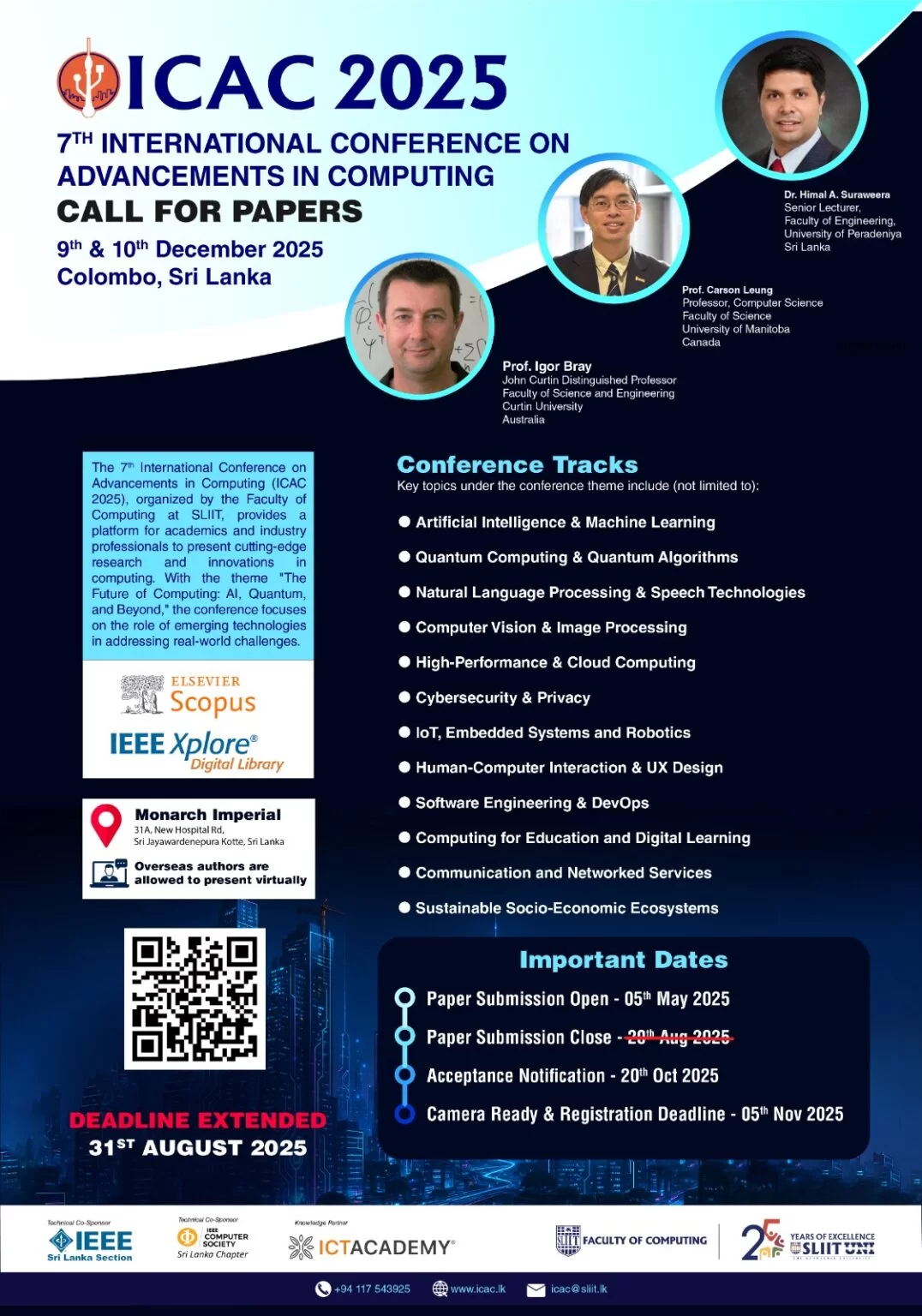
The International Conference on Advancements in Computing (ICAC 2025) was successfully held on 9th and 10th December 2025 at the Monarch Imperial, Sri Jayawardenepura Kotte, Sri Lanka, in a fully physical format. The conference was organised by Sri Lanka Institute of Information Technology (SLIIT) as the main organising unit, in collaboration with the IEEE Sri Lanka Section, IEEE Communications Society, IEEE Computer Society Sri Lanka Chapter, IEEE Robotics and Automation Society Sri Lanka Chapter, and IEEE Women in Engineering Sri Lanka Affinity Group. Themed “The Future of Computing: AI, Quantum, and Beyond”, the conference provided a prestigious platform for academics, researchers, industry professionals, and students to exchange knowledge on emerging trends in computing.
The inauguration was graced by Prof. Lalith Gamage, Vice Chancellor and CEO of SLIIT, who served as the Chief Guest. His address highlighted the growing role of advanced computing technologies in shaping innovation, research excellence, and socio-economic development, setting a strong foundation for the two-day technical programme.
The technical programme comprised a Plenary Session and 27 technical sessions, structured under 12 thematic tracks aligned with the conference theme. These tracks covered a wide spectrum of contemporary computing domains, including Quantum Computing and Algorithms, Artificial Intelligence and Machine Learning, Natural Language Processing and Speech Technologies, Computer Vision and Image Processing, High-Performance and Cloud Computing, Cybersecurity and Privacy, IoT, Embedded Systems and Robotics, Human-Computer Interaction and UX Design, Software Engineering and DevOps, Computing for Education and Digital Learning, Communication and Networked Services, and Sustainable Socio-Economic Ecosystems. The diversity of tracks ensured interdisciplinary engagement and rich technical discourse.
In addition to the main conference, five pre-conference workshops were conducted, offering hands-on exposure and focused discussions on emerging areas. These included workshops on IoT and Networking for Crisis Management, Confidential Federated Computing for Distributed Systems Security, Generative AI Tools for the Research Cycle, Text Analytics for User-Generated Content, and Agentic AI for Enterprise Digital Transformation. The workshops were facilitated by distinguished resource persons from reputed local and international universities and industry, enriching participants’ practical and research-oriented perspectives.
The conference received an impressive 462 paper submissions, of which 114 papers were accepted and presented following a rigorous peer-review process, reflecting the high academic standards of ICAC 2025. The event featured two keynote addresses and one invited talk by internationally recognised experts. The keynote by Prof. Igor Bray of Curtin University, Australia, explored high-performance and quantum computing approaches for atomic and molecular collision calculations. Prof. Carson Kai-Sang Leung from the University of Manitoba, Canada, delivered an impactful keynote illustrating how advancements in computing and big data analytics contribute to life-saving applications. An invited industry talk by Mr. Basavadarshan G N, Senior Academia Partnership Manager – APAC at MongoDB, provided valuable insights into academia–industry collaboration.
ICAC 2025 attracted a strong international presence, with 101 physical presenters, 275 physical participants, and 13 online presenters, representing universities, research institutions, and industries from Sri Lanka, Australia, Canada, Germany, India, Taiwan, the USA, Portugal, Malaysia, Brunei Darussalam, Scotland, and the United Kingdom.
The conference proceedings are published in IEEE Xplore and indexed in Scopus and Google Scholar (h-index: 16), ensuring global visibility and impact. Overall, ICAC 2025 successfully fostered collaboration, innovation, and knowledge dissemination, reinforcing Sri Lanka’s growing footprint in the global computing research landscape.
The inauguration was graced by Prof. Lalith Gamage, Vice Chancellor and CEO of SLIIT, who served as the Chief Guest. His address highlighted the growing role of advanced computing technologies in shaping innovation, research excellence, and socio-economic development, setting a strong foundation for the two-day technical programme.
The technical programme comprised a Plenary Session and 27 technical sessions, structured under 12 thematic tracks aligned with the conference theme. These tracks covered a wide spectrum of contemporary computing domains, including Quantum Computing and Algorithms, Artificial Intelligence and Machine Learning, Natural Language Processing and Speech Technologies, Computer Vision and Image Processing, High-Performance and Cloud Computing, Cybersecurity and Privacy, IoT, Embedded Systems and Robotics, Human-Computer Interaction and UX Design, Software Engineering and DevOps, Computing for Education and Digital Learning, Communication and Networked Services, and Sustainable Socio-Economic Ecosystems. The diversity of tracks ensured interdisciplinary engagement and rich technical discourse.
In addition to the main conference, five pre-conference workshops were conducted, offering hands-on exposure and focused discussions on emerging areas. These included workshops on IoT and Networking for Crisis Management, Confidential Federated Computing for Distributed Systems Security, Generative AI Tools for the Research Cycle, Text Analytics for User-Generated Content, and Agentic AI for Enterprise Digital Transformation. The workshops were facilitated by distinguished resource persons from reputed local and international universities and industry, enriching participants’ practical and research-oriented perspectives.
The conference received an impressive 462 paper submissions, of which 114 papers were accepted and presented following a rigorous peer-review process, reflecting the high academic standards of ICAC 2025. The event featured two keynote addresses and one invited talk by internationally recognised experts. The keynote by Prof. Igor Bray of Curtin University, Australia, explored high-performance and quantum computing approaches for atomic and molecular collision calculations. Prof. Carson Kai-Sang Leung from the University of Manitoba, Canada, delivered an impactful keynote illustrating how advancements in computing and big data analytics contribute to life-saving applications. An invited industry talk by Mr. Basavadarshan G N, Senior Academia Partnership Manager – APAC at MongoDB, provided valuable insights into academia–industry collaboration.
ICAC 2025 attracted a strong international presence, with 101 physical presenters, 275 physical participants, and 13 online presenters, representing universities, research institutions, and industries from Sri Lanka, Australia, Canada, Germany, India, Taiwan, the USA, Portugal, Malaysia, Brunei Darussalam, Scotland, and the United Kingdom.
The conference proceedings are published in IEEE Xplore and indexed in Scopus and Google Scholar (h-index: 16), ensuring global visibility and impact. Overall, ICAC 2025 successfully fostered collaboration, innovation, and knowledge dissemination, reinforcing Sri Lanka’s growing footprint in the global computing research landscape.
ICIIS 2025
16 – 17 January 2026
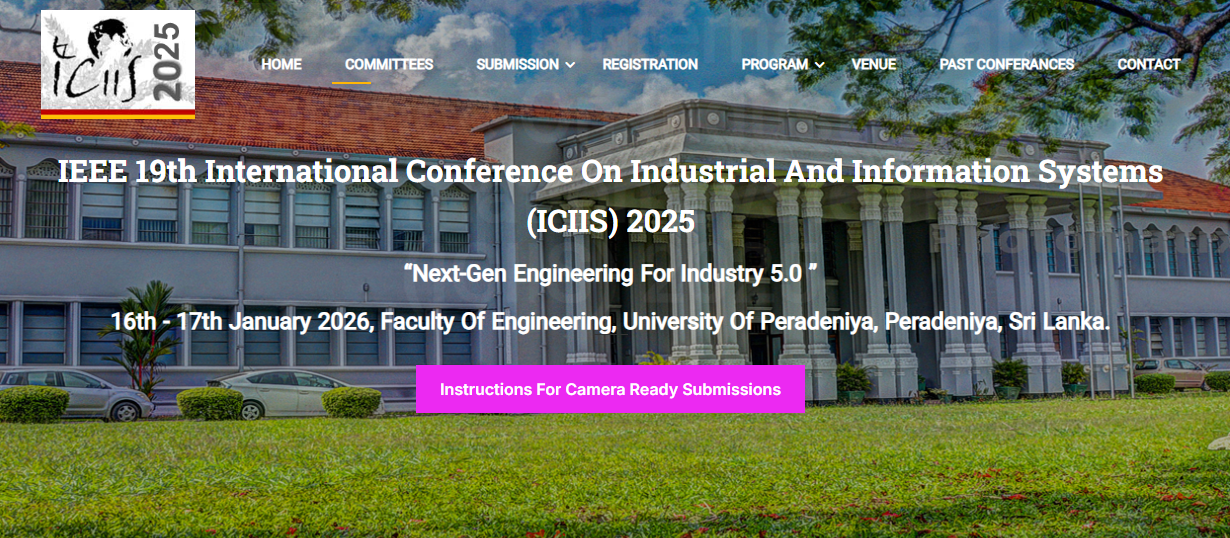
The International Conference on Industrial and Information Systems (ICIIS 2025) was initially scheduled to take place on 5–6 December 2025 at the Faculty of Engineering, University of Peradeniya, Kandy, Sri Lanka. However, due to the extensive flooding and landslides in the country in November 2025, the conference has been postponed to 16-17 January 2026. The Conference is technically co-sponsored by the IEEE Sri Lanka Section and will bring together academics, researchers, and industry professionals to exchange insights and showcase the latest advancements in automation, control, electronics, and information systems.
The programme will feature keynote speeches, technical sessions, and networking opportunities covering areas such as communications engineering, power systems, computer systems, and instrumentation. The conference aims to bridge the gap between research and industry by promoting the exchange of practical knowledge and innovative solutions.
Recognised as a key event in Sri Lanka’s engineering calendar, ICIIS focuses on applied research and addresses current engineering challenges, encouraging collaboration across disciplines. With strong technical support from IEEE Sri Lanka Section, it offers a platform for participants to connect, learn, and contribute to advancing industrial and information systems locally and globally.
By gathering experts from various fields, ICIIS 2025 supports Sri Lanka’s vision of becoming a hub for technological growth and innovation.
The programme will feature keynote speeches, technical sessions, and networking opportunities covering areas such as communications engineering, power systems, computer systems, and instrumentation. The conference aims to bridge the gap between research and industry by promoting the exchange of practical knowledge and innovative solutions.
Recognised as a key event in Sri Lanka’s engineering calendar, ICIIS focuses on applied research and addresses current engineering challenges, encouraging collaboration across disciplines. With strong technical support from IEEE Sri Lanka Section, it offers a platform for participants to connect, learn, and contribute to advancing industrial and information systems locally and globally.
By gathering experts from various fields, ICIIS 2025 supports Sri Lanka’s vision of becoming a hub for technological growth and innovation.
Events
IEEE FYP Arena 2025 Showcases Undergraduate Engineering Excellence
14 December, 2025
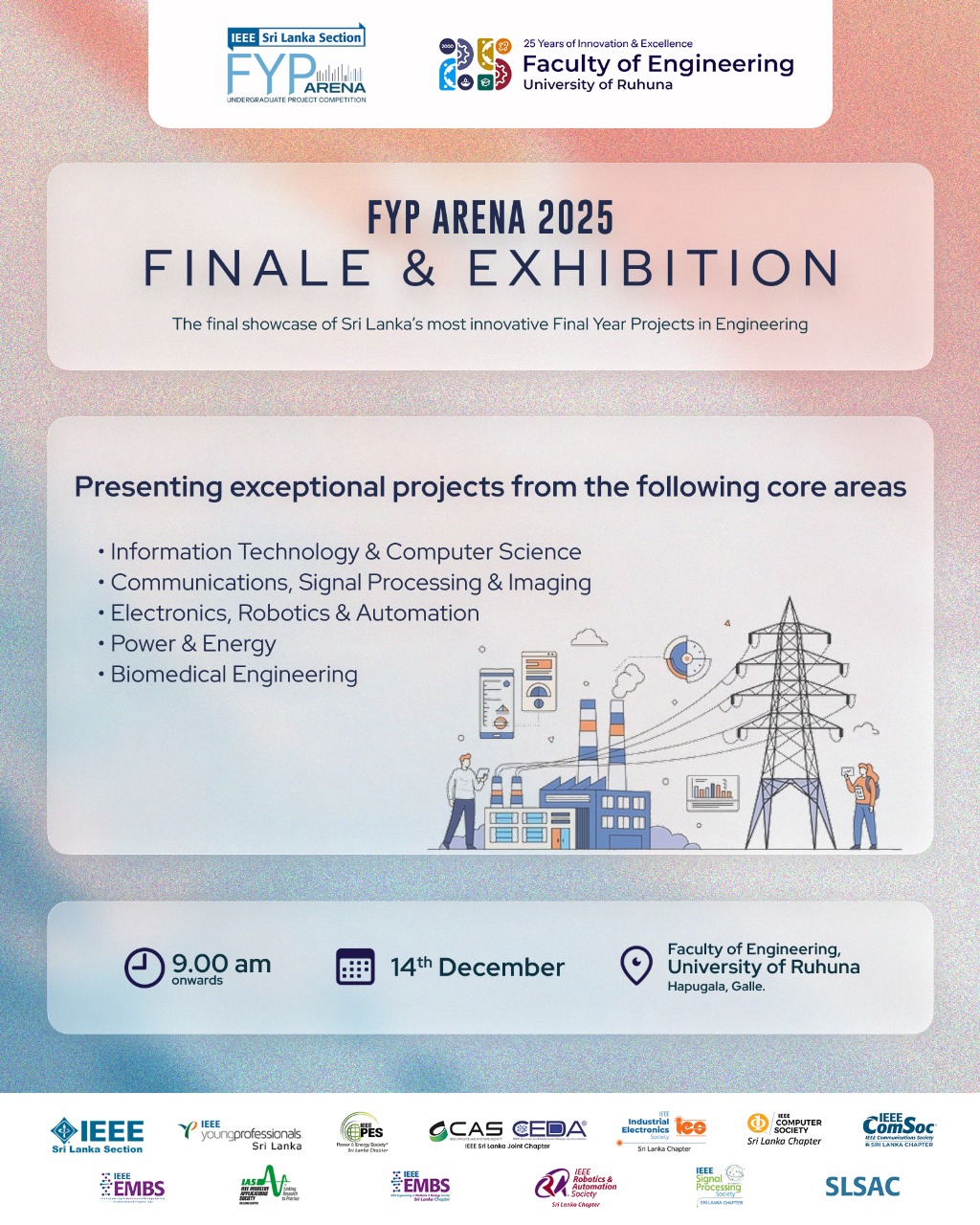
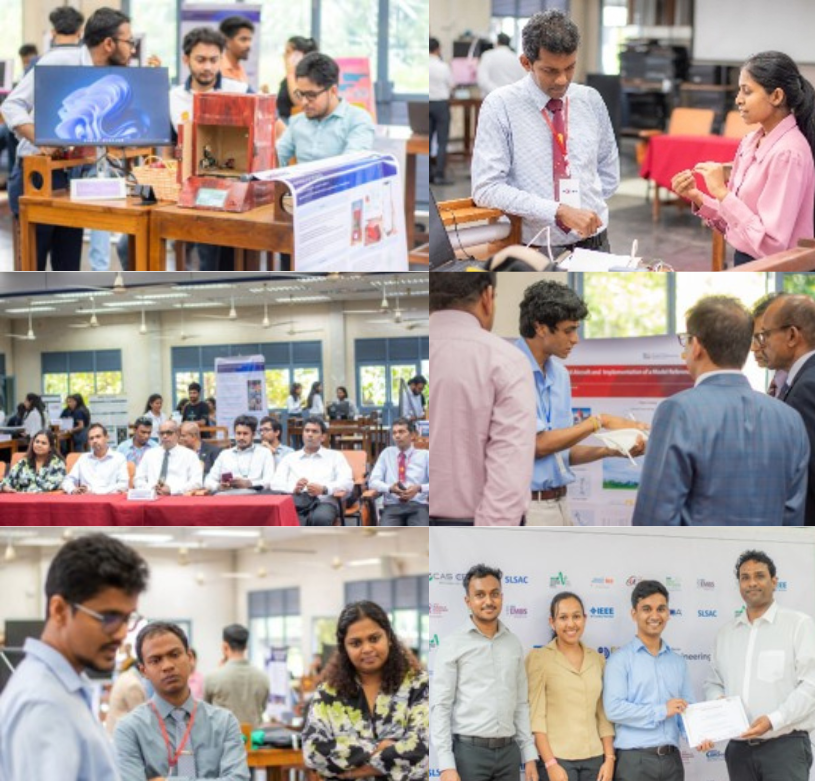
The IEEE Sri Lanka Section successfully organised IEEE FYP Arena 2025, a national-level Final Year Project competition, on 14 December 2025 from 9.00 am to 5.00 pm at the Faculty of Engineering, University of Ruhuna. The event was held in parallel with ReXtro 2025, the Silver Jubilee Engineering Exhibition celebrating 25 years of engineering excellence at the University of Ruhuna.
The competition provided a platform for final-year undergraduates from universities across Sri Lanka to present innovative, application-oriented engineering projects addressing real-world challenges across diverse domains.
IEEE FYP Arena 2025 enabled meaningful interaction with IEEE professionals and academics, offering national-level exposure while reinforcing IEEE’s commitment to empowering young engineers and advancing technology for societal benefit.
The competition provided a platform for final-year undergraduates from universities across Sri Lanka to present innovative, application-oriented engineering projects addressing real-world challenges across diverse domains.
Winning Projects by Track
-
Biomedical Engineering:
“Non-invasive decision support system for the detection of varicose veins”
– General Sir John Kotelawala Defence University -
Power and Energy:
“Software tool for optimally designing external lightning protection systems”
– University of Moratuwa -
Electronics, Robotics, and Automation:
“Hybrid VTOL UAV with a model reference adaptive control system”
– University of Ruhuna -
Communication, Signal Processing, and Imaging:
“Real-time acquisition of chromatic derivatives for signal processing and machine learning applications”
– University of Moratuwa -
Information Technology and Computer Science:
“Multimodal AI system for detecting and predicting the freshness and ripeness of produce”
– University of Ruhuna
IEEE FYP Arena 2025 enabled meaningful interaction with IEEE professionals and academics, offering national-level exposure while reinforcing IEEE’s commitment to empowering young engineers and advancing technology for societal benefit.
ICPC Sri Lanka Regional 2026 – Awareness Session and Preparations
14 December, 2025
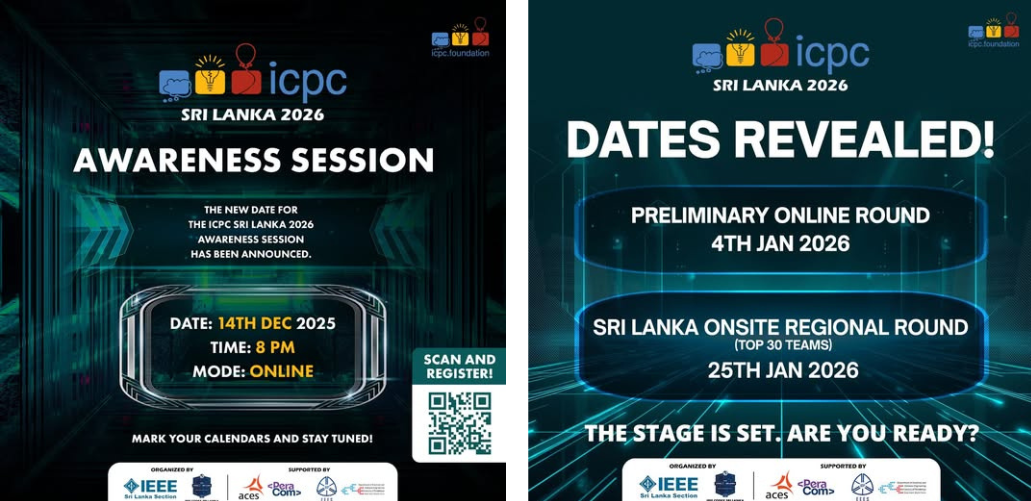
During December 2025, preparations for ICPC Sri Lanka Regional 2026 progressed to an execution-ready stage. On 14 December, an awareness session was conducted for prospective participants from universities across Sri Lanka, providing detailed guidance on competition structure, registration procedures, the qualification pathway, and ICPC’s role as an international competitive programming platform.
Throughout the month, organisational, technical, and logistical arrangements were finalised. University outreach activities supported awareness building, team formation, and institutional participation. Preparations for the preliminary online round, scheduled for 4 January 2026, were completed. Coordination with the University of Peradeniya was concluded for hosting the on-site regional round on 25 January 2026, including venue setup and logistical planning.
For further information, visit: icpc.ieee.lk.
Throughout the month, organisational, technical, and logistical arrangements were finalised. University outreach activities supported awareness building, team formation, and institutional participation. Preparations for the preliminary online round, scheduled for 4 January 2026, were completed. Coordination with the University of Peradeniya was concluded for hosting the on-site regional round on 25 January 2026, including venue setup and logistical planning.
For further information, visit: icpc.ieee.lk.
Future Networks Fostering 6G
Collaboration and Research
05 December 2025
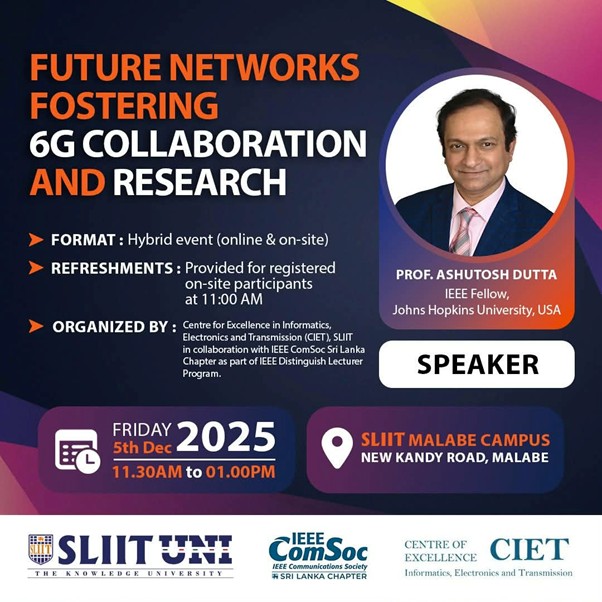
The final Distinguished Lecturer Programme for the year was held on 5th December 2025, featuring Prof. Ashutosh Dutta, IEEE Fellow, Johns Hopkins University, USA, who is globally recognised for his contributions to next-generation communication systems. The event was held in collaboration with the IEEE ComSoc Sri Lanka Chapter, the Centre for Excellence in Intelligent, Electronics and Transmission (CIET), Faculty of Engineering, SLIIT. The lecture provided a comprehensive outlook on the evolution toward 6G, addressing key technological advancements, global research initiatives, security considerations, and opportunities for collaborative innovation. The session was conducted in hybrid mode.
Annual General Meeting & Members’ Night 2026
12 January 2026
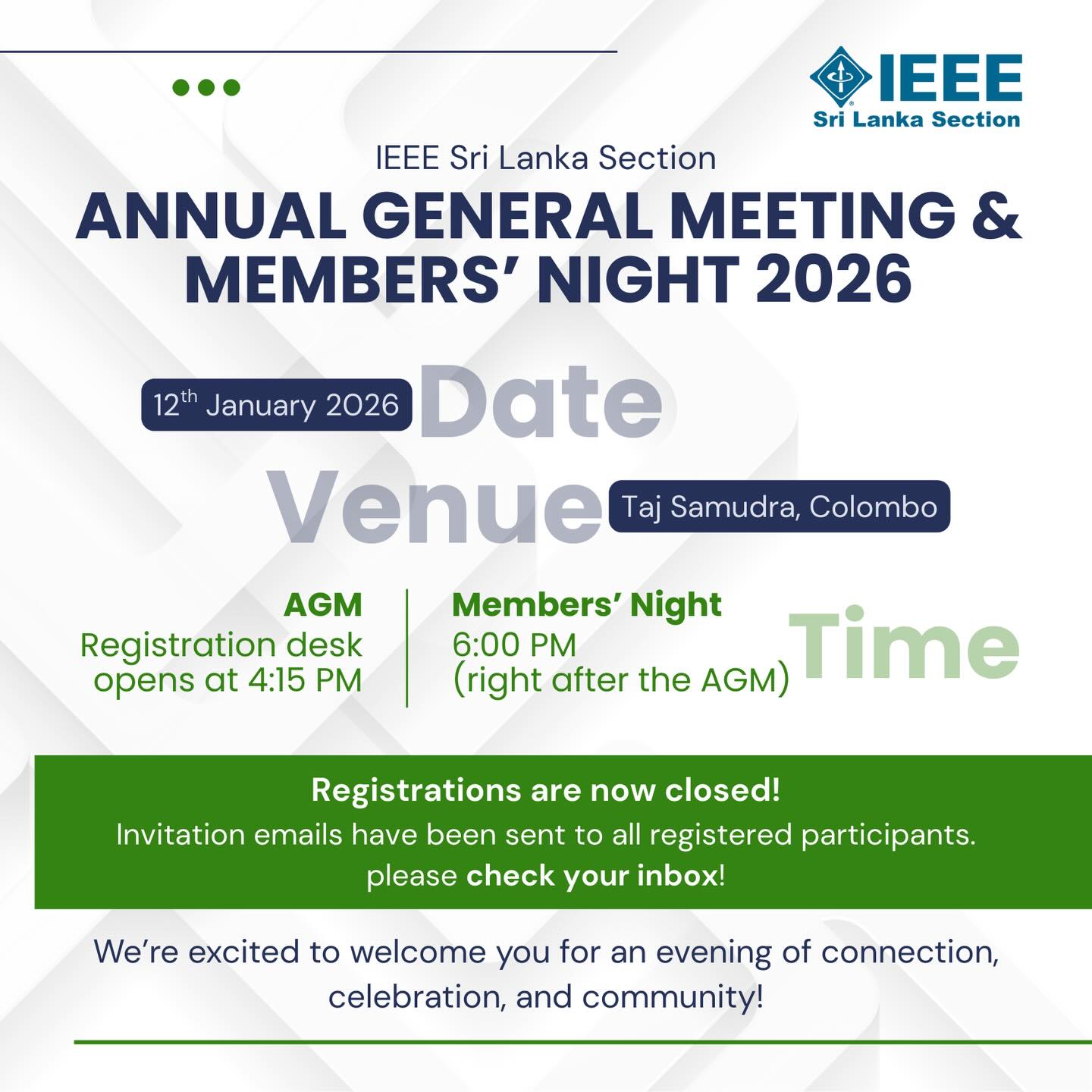
The IEEE Sri Lanka Section will come together in solidarity on the 12th of January 2026 at the Taj Samudra in Colombo to conduct its Annual General Meeting and Members’ Night, with members expected to attend from all across the nation.
The AGM will mark an important transition, as it will officially conclude the 2025 term and see the election of a new committee for the year 2026. Members will take this opportunity to reflect on the achievements of the past year and outline their vision and priorities for the years ahead.
Following the formal proceedings, Members’ Night will commence and set the tone for a lively and engaging evening. This will provide an excellent opportunity for members from the professional and academic sectors, as well as industry representatives, to network, interact, and celebrate the collective strength of the IEEE Sri Lanka Section, which is driven by the expertise, dedication, and diverse skill sets of its membership.
With a new leadership team in place and continued support from the community, the IEEE Sri Lanka Section will look forward to another exciting year of growth, innovation, and meaningful contributions to the engineering and technology industry.
The AGM will mark an important transition, as it will officially conclude the 2025 term and see the election of a new committee for the year 2026. Members will take this opportunity to reflect on the achievements of the past year and outline their vision and priorities for the years ahead.
Following the formal proceedings, Members’ Night will commence and set the tone for a lively and engaging evening. This will provide an excellent opportunity for members from the professional and academic sectors, as well as industry representatives, to network, interact, and celebrate the collective strength of the IEEE Sri Lanka Section, which is driven by the expertise, dedication, and diverse skill sets of its membership.
With a new leadership team in place and continued support from the community, the IEEE Sri Lanka Section will look forward to another exciting year of growth, innovation, and meaningful contributions to the engineering and technology industry.
Introductory and Networking Session
with the IEEE Sri Lanka Section and
IEEE Region 10 Operations Committee (R10 OpsCom)
09 January 2026
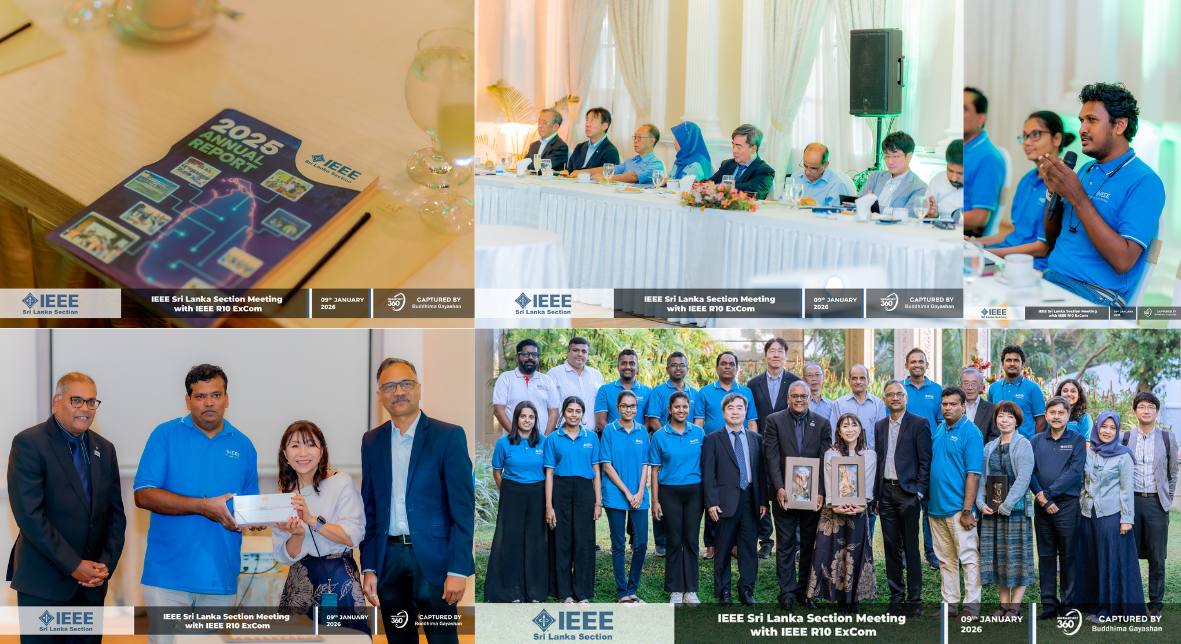
The Introductory and Networking Session with the IEEE Sri Lanka Section and the IEEE Region 10 Operations Committee (R10 OpsCom) was held on 9th of January 2026 at the Taj Samudra Hotel in Colombo, Sri Lanka. This meeting is to foster strategic engagement, mutual understanding, and collaborative dialogue between regional leadership and the local IEEE community. The following R10 OpsCom participated from IEEE Region R10.
- Prof. Takako Hashimoto (Director IEEE R10)
- Prof. SM Sameer (Director IEEE Elect R10)
- Prof. Nirmal Nair (Director IEEE Elect R11)
- Mr. Deepak Mathur (Past Director IEEE R10)
- Prof. Michael Ong (Section Chair, Singapore Section)
- Ms. Emi Yao
- Prof. Kohei Ohno
- Prof. Cheon Won Choi
- Dr. Kurnianingsih



Copyright © IEEE Sri Lanka Section 2025. All rights
reserved.